We are excited to welcome students back for another academic year. As we enter the 26/27 academic year, I want to start with a few updates.
Parking
This academic year we increased student permits by 100, issuing 1,400 permits for the fall semester. Emails were sent to all students in April, May, June and July, and the window for juniors and seniors was from May 18th through July 18. We issued permits to 1,080 juniors and seniors who registered, leaving 320 permits for sophomores, more than 500 of whom requested one. When the new tiered parking lots are completed behind Christy Mathewson–Memorial Stadium later this fall, we plan to further expand student permits to 1,500 in the spring semester.
Flock Gunshot Detection
To help law enforcement and University officials more quickly assess reports of gunfire, Bucknell is installing Flock Raven gunshot detection devices around the perimeter of the main campus. When gunfire is detected, Raven’s audio sensors can identify the approximate location where the weapon was discharged, supporting a faster and more targeted response.
Raven devices only detect audio associated with gunfire. They are not cameras, do not capture video and do not read license plates. They do not record human conversations or monitor them. Fireworks have a completely different acoustic sound from gunshots. The system works off acoustic signatures, and a firearm has a completely different signature than a gunshot.
The Raven system will support both emergency response and the assessment of potential hoax reports. During an actual shooting, it can help responders identify where gunfire occurred and reach the appropriate location more quickly. When an active-shooter report is suspected to be a swatting incident, data from the system can help officials determine whether gunfire was detected in the reported area.
Similar technology has been adopted by other universities, including Georgia Tech, Auburn and Purdue. The devices will strengthen Bucknell’s emergency-response capabilities as swatting incidents continue to affect campuses nationwide.
Raven devices will be installed near roads and buildings throughout the main campus, as well as near Bucknell West, the Sunflower Child Care Center and James Alley (between St. Catherine and St. George streets).
Active Shooter Drill
On July 28, we hosted our fourth annual active shooter drill. During the last academic year, Bucknell was among several institutions that received swatting calls that focused on a library, so we chose Bertrand Library as the site of this year’s drill, which was run by our own Lt. Colbey Russell.
Officers from Mifflinburg, Buffalo Valley Regional Police, the William Cameron Fire Department, and the PA State Police participated in the drill, along with Bucknell Public Safety, Union County Sherriff Dept, Union County EMA, and staff from Wellspan Evangelical. Several members of the Bucknell community assisted as role players. Exercises included a response to a threat, medical triage and implementing incident command. Representatives from the Cybersecurity and Infrastructure Security Agency were present to assess law enforcement response.
This annual drill is a culmination of training that Public Safety officers and staff receive throughout the year. Training with our local law enforcement partners is critical to ensure effective response and communication in a multi-agency event. We thank everyone who participated in this effort.
Community Feedback
In March 2026, the Department of Public Safety partnered with Institutional Research & Analytics to conduct comprehensive surveys of students and employees. These findings, combined with the Class of 2025 Senior Survey data, provide a data-informed foundation for strategic planning. After reviewing the findings, we created the following priorities. We want to give the community an opportunity to respond and provide feedback before final adoption in December — please share your feedback with publicsafety@bucknell.edu. We plan to hold a listening session for the community later this fall. Please watch the Message Center for additional details this fall.
Priority 1: Elevate Customer Service and Interpersonal Engagement
Goal: Ensure consistent, professional and empathetic interactions across all touchpoints.
Actions: Formalize body camera and dispatch call recording review with metric based scoring to quantify interactions, enhance departmental training related to soft skills, assign divisional leaders specific tasks to measure compliance, implement new praise mechanisms to acknowledge publicly outstanding performance, review policies and organizational expectations to ensure they align with strategic priorities, empower employees to review their interactions to self-correct, and determine if a marketing campaign is needed to help the community better understand the role of Public Safety.
Priority 2: Enhance Response Time and Operational Effectiveness
Goal: Improve response times and align service delivery with community expectations.
Action: Conduct timely audits of response times and establish baselines for call response.
Priority 3: Expand Community Engagement
Goal: Increase meaningful and intentional engagement with the campus community.
Action: Continue to find new pathways and partnerships for proactive engagement with the community we serve.
Priority 4: Evaluate Technology and Safety Resources
Goal: Ensure technology and tools effectively support safety and engagement.
Action: Ensure the community understands the tools and technologies within our purview and how we use them.
Priority 5: Align Resources with Community Needs
Goal: Optimize resource allocation to address priority concerns.
Action: Continually review fiscal planning to ensure departmental expenditures reflect community priorities.
Trainings
Public Safety has certified instructors on staff for the following classes, most of which are offered at no charge. Use this form to request and schedule a class.
ALICE Training is the original civilian active shooter response training delivered with a trauma-informed approach in an age- and ability-appropriate way. More information can be found at ALICE Training Model.
Class Length: 90 minutes
Max Attendees: No limit
Cost: $0
AVADE Personal Self-Defense provides informative, proactive prevention strategies and interventions that can help prevent and mitigate fear, conflict and aggression while creating a culture of safety. More information can be found at AVADE Workplace Violence Prevention.
Class Length: 90 minutes
Max Attendees: 12
Cost: $0
Basic Car Maintenance teaches the basics of troubleshooting common car issues such as changing a tire, jumping a dead battery and checking the oil. This is a general overview and demonstration for individuals and groups. Individual requests tailored to specific makes and models may also be requested and will be accommodated if possible.
Class Length: Varies
Max Attendees: Varies
Cost: $0
Fraud Awareness teaches participants how to identify common tactics used to defraud and exploit the kindness of others.
Class Length: 30 minutes
Max Attendees: No limit
Cost: $0
Heartsaver CPR AED (group requests only) is a classroom, video-based, instructor-led course that teaches adult CPR, AED use and choking relief. This course uses AHA’s research-proven, practice-while-watching technique, which allows students to mimic accurate skills being performed on the video while instructors provide feedback and guide the students’ skill learning. More information can be found at American Heart Association Heartsaver.
Class Length: 90 minutes
Max Attendees: 6-8 per class — we can schedule multiple classes to certify everyone in a group
Cost: $20 per participant (this covers the cost of necessary supplies and the $17 fee charged by AHA for certification card registration). Invoice will be sent directly from WellSpan Evangelical Community Hospital on behalf of the American Heart Association.
Narcan/Naloxone Administration & Distribution teaches participants how to recognize the signs of an opioid overdose and administer the opioid overdose reversal drug Naloxone. Narcan kits will be provided to all participants. Hosted in collaboration with Sheila Packer RN, WellSpan Evangelical Community Hospital community educator.
Class Length: 60 minutes
Max Attendees: No limit
Cost: $0
Situational Awareness teaches participants methods and strategies to help them be prepared rather than paranoid when dealing with challenging situations.
Class Length: 60 minutes
Max Attendees: No limit
Cost: $0
Other Topics: Public Safety is fortunate to have many team members with a wide variety of experience and expertise. If there’s a topic that you would like more information about, or for any engagement opportunity you’d like Public Safety to participate in, send us a request at publicsafety@bucknell.edu.
Automated External Defibrillators
As part of our commitment to safety, we have added new AED devices in the residence halls listed below as well as in the Outdoor Education & Leadership program. We thank Associate Dean for Health & Wellness Lauren Strunk for leading the charge to make this possible. Locations of all campus AED devices can be found on this updated map.
- Vedder Hall
- Swartz Hall
- McDonnell Hall
- Smith Hall
- Larison Hall
- Roberts Hall
- Trax Hall
- Harris Hall
- Kress Hall
- West Apartments Bldg 5
- South Campus Apartments, Bldg 3
- Gateways, Kalman-Posner
- Hunt Hall
- West Apartment, Bldg 1
- South Campus Apartments, Bldg 1
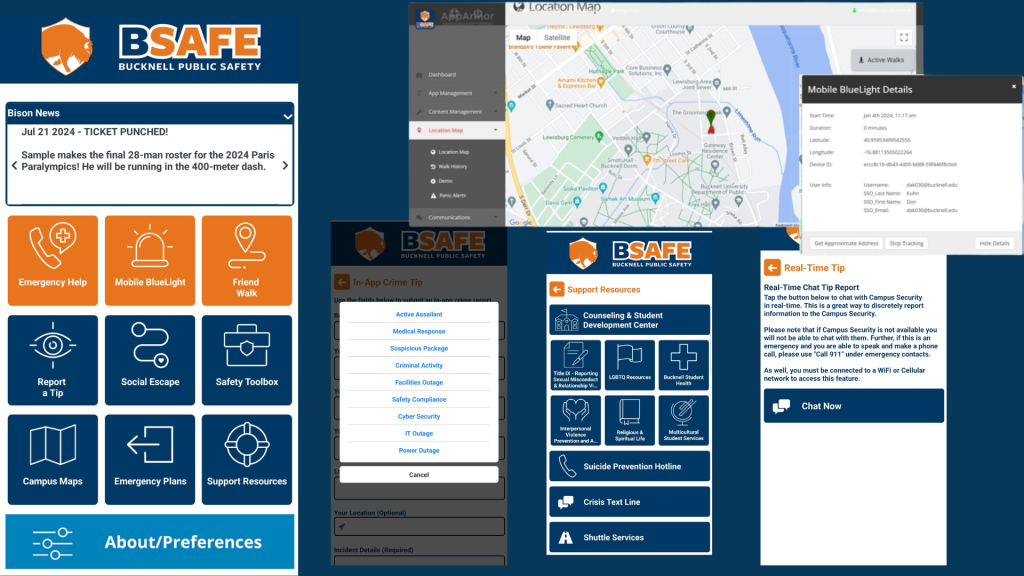
BSAFE App
If you have not downloaded the BSAFE App, we encourage you to do so as soon as possible.
Tips for Staying Safe
Know how to contact Public Safety: Call us 24/7 at 570-577-1111 (emergency) or 570-577-3333 (other calls). You can also reach us through the BSAFE app and via email at publicsafety@bucknell.edu.
Always lock your room door, register your bike and keep it locked up, and do not leave valuable personal items unattended. If you register your bike, you can receive a free bike lock.
Safeguard your personal information, as phishing and phone scams are common. Do not give out your personal information without verifying the legitimacy of the person sending the email or making the phone call. If you have questions about the legitimacy of an email, contact us at publicsafety@bucknell.edu.
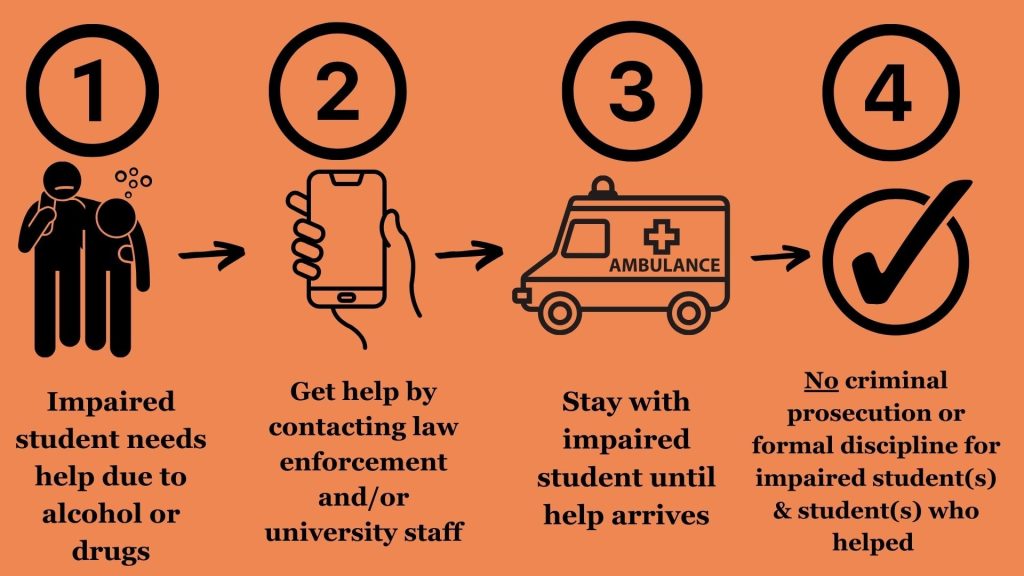
Understand medical amnesty and when it applies. Bucknell prioritizes student safety by offering medical amnesty when a student calls for medical assistance on behalf of another who is impaired due to alcohol or drug use. Under the medical amnesty policy, the student placing the call and the student for whom the call was made will not be subject to the student conduct process for alcohol or drug violations. Further, when the leadership of a recognized student organization makes a call for help for any student attending their event, the organization will not be subject to code of conduct sanctions for alcohol or drug violations. The graphic below summarizes the medical amnesty policy.
Bucknell offers many more support resources, which you can find by downloading the BSAFE app. Please take the time to get to know the resources we provide for you.